Programming Languages
Software Engineering Phases -

There are four fundamental phases in most, if not all, software engineering methodologies. These phases are analysis, design, implementation, and testing. These phases address what is to be built, how it will be built, building it, and making it high quality. . These steps together define the cradle-to-grave life cycle of the software project. Obviously, if an action is done many times, it needs to be done correctly and efficiently.

Computer Training Excuses -

You wouldn't go to a doctor who had never been to medical school, or hire a lawyer who never studied law. One side-effect of a world advancing as rapidly as ours is that fields are becoming more and more specialized and narrow. People can no longer get by on general knowledge in their careers, something I found out for myself not too long ago. I'd been out of high school for two years, scraping by on my own and picking up scraps of programming as I went. I saw all of the self-taught programmers breaking into the IT industry, and I hoped to do the same. After all, IT is one of the few industries out there where being creative and a quick learner is more important than a degree.
Which is the Easiest Programming Language? -

If you have some misconception in mind that the programming languages are easy or hard, I am afraid to say that you are mistaken. To tell you frankly about the programming languages, there is nothing such as easy or tough programming language. The only thing that you need to keep in mind while stepping into the world of programming languages is that which programming language would set your base by giving you in-depth knowledge of programming logics and the basics of programming techniques.
Entering into Programming World -

Once you have learned some programming languages, you feel yourself completely prepared to enter into the programming world, and start working on the programming languages that you have learned. Many students also feel that they have learned extra things which might be helpful in their programming careers. The matter of fact is that the real world is entirely different from what you have been taught in the classrooms.
Why Programmers Love the Night -

One famous saying says that programmers are machines that turn caffeine from coffee and Coca Cola into a programming code. And if you
ask a programmer when does he like working the most and when is he most productive - he is probably going to say late at night or early in the morning, that is when he has the greatest energy and concentration to work.
How to be a Programmer -

To be a good programmer is difficult and noble. The hardest part of making real a collective vision of a software project is dealing with one's coworkers and customers. Writing computer programs is important and takes great intelligence and skill. But it is really child's play compared to everything else that a good programmer must do to make a software system that succeeds for both the customer and myriad colleagues for whom she is partially responsible. In this essay I attempt to summarize as concisely as possible those things that I wish someone had explained to me when I was twenty-one.
TW Tech Glossary - Misplaced your bible? Well here it is - Tech Glosasary! This truly took a while to complete and should be used by all from beginners to advance techies.
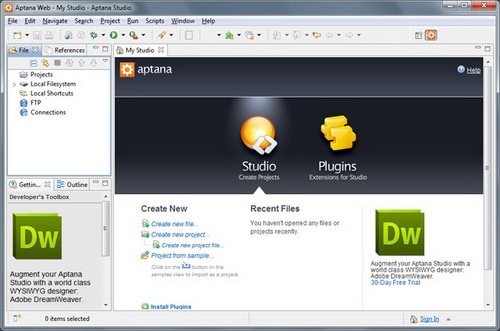
How to Install the Aptana Studio IDE on Windows -
IDE
(Integrated Development Environment) represents an integrated development environment in which you can develop applications. This tutorial will be useful to all those that considering doing programing...
What Programming Language To Learn -
One of the most common questions we hear from individuals hoping to enter the IT industry is, "
What programming languages do I need to know?" Obviously this is a complex question, and the answer will depend on what field the questioner is going into. Many programming languages are taught during courses used to obtain a computer information science degree. However, those already in IT know that the greatest skill you can have is to be a jack-of-all-trades. A well-prepared worker can switch between computer programming jobs with only minimal training, thanks to a wide knowledge of multiple programming languages.
What is Assembly Programming Language?
But before we start, let's first ask more foundational questions:
What Is Machine Language?
Although programmers tend to use C or C++ or Pascal these days, the language closest to the PC hardware is machine language. Not one second during a PCS powered on lifetime passes where the computer is not executing machine language.
Assembly Language Or Machine Language
 To word this simply, you can say that say that assembly language is a human-readable text, and machine language is machine-readable binary code. When you program in assembly language, you are programming on the machine language level.
To program directly in machine language is tedious, so you use assembly language instead, and use an assembler to produce the actual machine code.
When To Use Assembly Language
I personally think that except as a learning exercise it's a waste of time writing something in asm that can be written acceptably fast in a high-level language.
Assembly language fits for the following:
- Low level control. When you need to change the flags, or the control registers of the processor, as when entering protected mode.
- Speed. Programs written in machine language execute fast! It can execute 10-100 times the speed of BASIC, and about twice as fast as a program written in C or Pascal.
- Time Critical Code. Critical sections of programs written in higher level languages, can be written in assembly to speed up sections.
- Small program size. When you write a TSR for example this is very useful. Writing interrupt handlers is where assembly language shines.
Assembly language is very flexible and powerful, anything that the hardware of the computer is capable of doing can be done in assembly.
Each type of CPU has its own machine language and assembly language, so an assembly language program written for one type of CPU won't run on another. In the early days of programming, all programs were written in assembly language. Now, most programs are written in high-level languages. Programmers still use assembly language when speed is essential or when they need to perform an operation that isn't possible in a high-level language.
Tips
Hello World in Assembly:
write(int fd, char *Buff, int NumBytes);
|
|
|
|
 Did You Know?
- Assembly Programming is thought of by many as the hardest and the most rigorous programming language.
- In the 1940s, the first recognizably modern, electrically powered computers were created. The limited speed and memory capacity forced programmers to write hand tuned assembly language programs. It was eventually realized that programming in assembly language required a great deal of intellectual effort and was error-prone.

|
|
|
|
|
|